Real-Time Tracking in Advisor Transitions: Why 'Where Are My Accounts?' Is No Longer Acceptable
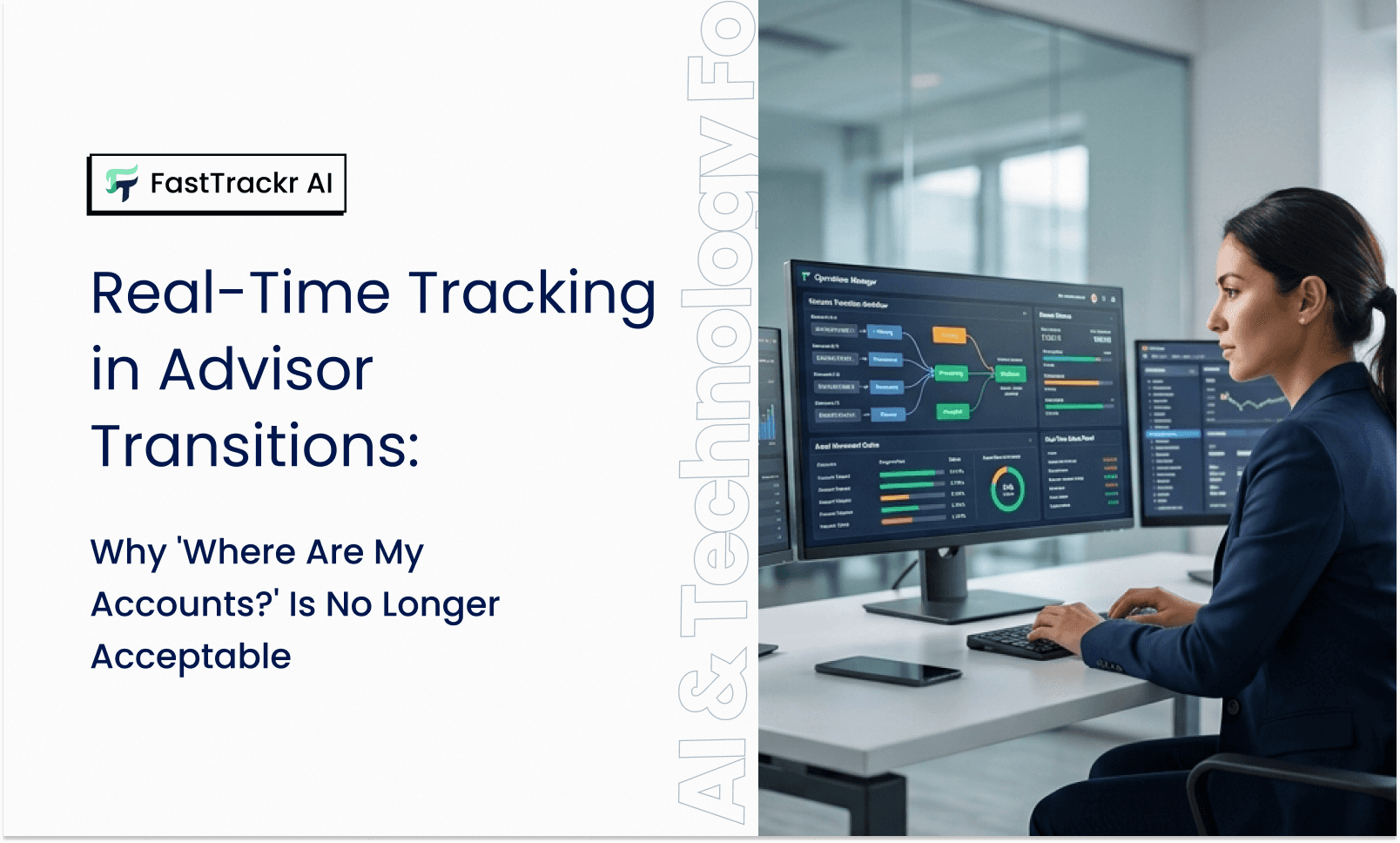
Most advisor transitions don't provide real-time account status visibility because the industry has normalized uncertainty as part of the process. The result? Advisors field 5–10 client calls a day asking "where is my account?" while ops teams send manual status updates via email. That's not a client experience problem. That's a data infrastructure failure. In 2026, growth-focused RIA owners should demand live dashboards showing account status, form submission state, custodial processing stage, and projected completion dates. Transition technology that can't answer "where are my accounts?" in real time isn't transition technology. It's a more expensive spreadsheet.
Why Most Transition Platforms Don't Offer Real-Time Tracking
The absence of real-time tracking isn't a deliberate omission. It's a byproduct of how most advisor transition workflows were built.
Most platforms were designed as forms libraries or workflow orchestration tools. Not data infrastructure layers. They process documents. They don't track assets.
When a new account form is submitted to Fidelity or Schwab, the custodian processes it on their own timeline — without pushing status updates back to the submitting firm's systems. That data gap creates the black box advisors describe during every transition. The account was submitted. Then silence.
No mechanism to check status without calling the custodian directly. And most custodians don't prioritize inbound status calls from transitioning advisors.
For a growth-focused RIA, this isn't a minor inconvenience. Each status inquiry consumes 15–20 minutes of advisor time. It erodes client confidence at the exact moment those clients are deciding whether they made the right move.
What Real-Time Tracking Actually Means in a Transition Context
Real-time tracking in an advisor transition has two distinct layers. Both matter.
Form submission tracking monitors whether paperwork has been completed, submitted, and received by the custodian. It flags NIGOs, tracks signature status, confirms form delivery. This is the upstream layer — it tells you whether the paperwork is clean.
Account transfer tracking monitors the custodial processing stage: whether the ACATS transfer has been initiated, whether the receiving custodian has accepted the request, whether assets are in transit, whether the account has fully settled. This is the downstream layer — it tells you whether money is moving.
Most existing transition tools handle only the first layer, if any. Full transition visibility requires both — and the ability to surface them in a single dashboard tied to each individual account in the book.
Per SEC guidance on ACATS transfers, standard ACATS transfers should complete in no more than 6 business days from form entry. Any platform that can't tell you which day of that 6-day window you're on isn't giving you real information.
The Client Attrition Cost of Not Knowing
The business case for real-time tracking isn't operational convenience. It's client retention.
Transitions are the highest-risk moment in an advisor-client relationship. The client has already signed new account paperwork. Their assets are in motion. Their financial life is temporarily fragmented across two custodians. And they have one question: "Is my money safe and will it get there?"
When advisors can't answer that question with confidence — because they don't have visibility themselves — clients feel abandoned. That feeling doesn't resolve when the accounts arrive. It calcifies into a permanent reduction in trust. Sometimes it accelerates a second move that the advisor never sees coming.
Put numbers to it. For a $500M AUM transition at 0.8% annual fee, one day saved in the transition timeline is approximately $10,000 in additional revenue. Sixty days saved — achievable just by eliminating manual status-check loops — translates to $600,000. But those are the recoverable numbers.
Client attrition triggered by poor communication during the transition is permanent revenue loss. It never appears in the ROI model because the advisor doesn't know it happened.
What a Real-Time Transition Dashboard Should Show
A capable transition tracking system should surface, per account, at minimum:
Form status layer:
- Form completed (yes / no / partial)
- E-signature collected (all parties)
- NIGO flags — specific field errors preventing submission
- Form submitted to custodian (with timestamp)
- Custodian receipt confirmed
Transfer status layer:
- ACATS transfer initiated
- Transfer request accepted by delivering custodian
- Assets in transit
- Account fully settled at receiving custodian
- Exceptions — account holds, rejected transfers, manual processing required
Portfolio-level summary:
- Total accounts in transition: X
- Fully settled: Y
- In process: Z
- Flagged / requiring action: N
This level of visibility changes the advisor-client conversation entirely.
Instead of "I'm not sure, let me check" — the advisor says: "Your bond accounts settled Monday. Your equity positions are in transit and should settle by Thursday. The only outstanding item is the beneficiary form for your IRA, which we sent you this morning."
That's the difference between a transition that loses clients and one that deepens them.
How Advisors Can Use Tracking Data to Communicate Proactively
The highest-value use of real-time tracking isn't internal operations. It's proactive client communication.
When an ops team can see that 200 accounts settled cleanly over the weekend, they can trigger client notifications before clients even think to call. When 12 accounts flag a NIGO at the custodian, those specific clients hear about it within hours — not days.
This shifts the transition experience from "radio silence punctuated by bad news" to "regular updates that demonstrate competence and care." Per Wealthmanagement.com, the perception of transition quality is driven more by communication cadence than by the speed of the transition itself.
Advisors who transition quickly but communicate poorly lose more clients than advisors with a messier transition who over-communicate every step. Real-time tracking enables the communication. The commitment to use it has to come from the advisor.
Frequently Asked Questions
Why don't most advisor transition platforms provide real-time account status?
Most transition platforms were built as forms libraries or document workflow tools, not data infrastructure layers. They process paperwork but don't have direct API integrations with custodians to pull real-time status updates back. That creates a data gap between form submission and asset settlement — the black box that advisors describe during every transition.
What information should RIA owners be able to see in real time during a transition?
At minimum: form completion status for each account, e-signature status, NIGO flags, custodian receipt confirmation, ACATS transfer stage (initiated, accepted, in transit, settled), and any accounts requiring manual intervention. All of this should be visible at the individual account level and aggregated at the portfolio level in a single dashboard.
How does a lack of transition visibility lead to client attrition?
When advisors can't answer "where is my account?" with specific, confident information, clients interpret that silence as incompetence — or as a signal something has gone wrong. That erosion in trust rarely reverses. Some clients accelerate a second move to a different advisor, one the original advisor never sees coming because the decision was made quietly, during the transition itself.
What's the cost of managing status updates manually vs. having a live dashboard?
For a 500-account transition, manual status management can consume 20–30 staff-hours per week — dedicated ops staff calling custodians and relaying status to advisors by email. A live tracking dashboard eliminates that entirely. For a $500M AUM transition, the revenue captured by eliminating manual process delays alone exceeds $600,000.
What's the difference between tracking repapering status vs. tracking AUM transfer status?
Repapering tracking monitors the paperwork — whether forms are complete, signed, and accepted. AUM transfer tracking monitors the assets — whether holdings are moving between custodians and settling correctly. Both are necessary. Repapering is the upstream signal; transfer status is the downstream confirmation. A complete tracking system connects them and flags when clean paperwork doesn't produce a clean transfer.
How do you communicate transition progress to clients in a way that builds trust?
Proactively and specifically, timed to each account's actual status. Not weekly generic updates. Account-specific notifications tied to milestones: "Your accounts at Schwab were received. Your equity holdings are in transit. Estimated settlement: Thursday." The more specific the communication, the more confidence it builds — even when the news includes a form that needs correction.
Why is "where are my accounts?" still a common client question in 2026?
Because the default state of most transitions is opacity. Custodians don't proactively notify transitioning advisors about asset movement. Most platforms don't pull that data automatically. Advisors have been conditioned to treat the transition period as a black box rather than demanding visibility from their technology. That expectation is changing. Most of the market hasn't caught up yet.
The Standard Has Changed
"We'll let you know when your accounts arrive" was acceptable in 2010.
In 2026, it's a liability. Clients expect the same visibility from their advisor during a transition that they get from a FedEx package — real-time location, estimated delivery, instant notification when something is delayed.
The transition firms that win growth in the next cycle won't be the fastest. They'll be the ones who can tell every client, at every moment, exactly where every account stands — and prove it.
If your current transition platform can't do that, the question isn't whether to upgrade. It's how much business you're losing while you wait.
Read More Articles

Step-by-Step Guide to Running a Zero-NIGO Advisor Transition for a $300M Book
Step-by-Step Guide to Running a Zero-NIGO Advisor Transition for a $300M Book
Understanding Custodial Transfer Requirements: ACATS vs. Non-ACATS for Advisor Transitions
Understanding Custodial Transfer Requirements: ACATS vs. Non-ACATS for Advisor Transitions
How to Automate Form Population Across Multiple Custodians for Advisor Transitions