Multi-Custodian Advisor Transitions: How to Handle Fidelity, Schwab, and Pershing in One Workflow
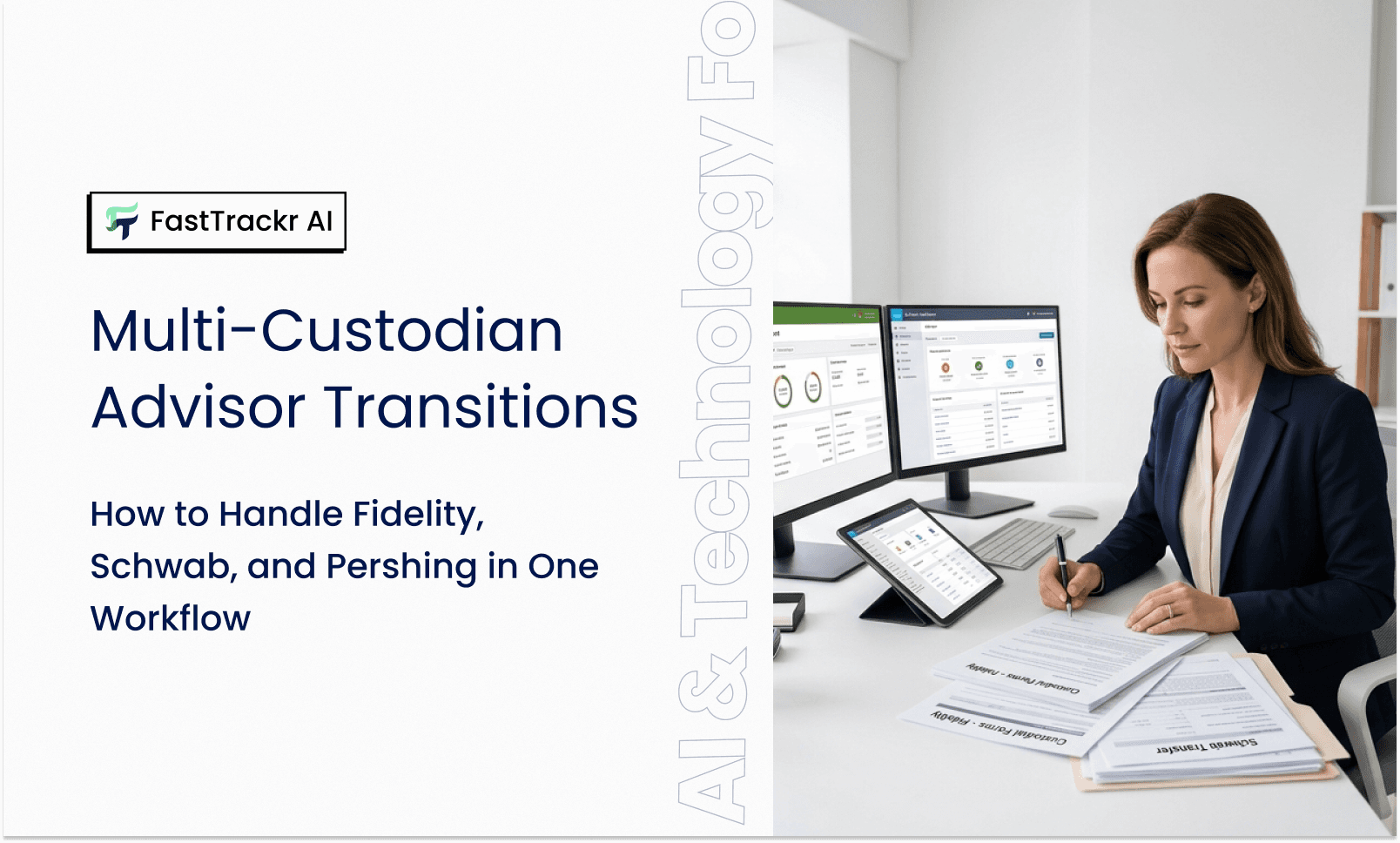
Multi-Custodian Advisor Transitions: How to Handle Fidelity, Schwab, and Pershing in One Workflow
Multi-custodian advisor transitions fail when ops teams treat them as three separate projects instead of one. The fix is architectural: collect all client data once at intake, apply custodian-specific form logic automatically as an output layer, and track status at the account level across all custodians in real time. One intake. One data model. Custodian-specific form output. That's the workflow. Everything else — the three spreadsheets, the duplicate data entry, the custodian-specific NIGOs — is what happens when you don't have it.
Nearly 30% of RIAs now use two or more custodians, according to AdvizorPro's 2025 RIA Custodian Trends Report. Multi-custodian transitions aren't edge cases anymore. They're the norm for growth-oriented firms. And most of the operational infrastructure for managing them hasn't kept pace.
The three-spreadsheet trap
The most common multi-custodian transition failure isn't a missing form. It's an architecture problem.
When ops teams build separate workflows for each custodian — a Fidelity spreadsheet, a Schwab spreadsheet, a Pershing spreadsheet — they've created three parallel processes sharing the same source data but maintaining it independently. Any update to a client's address, beneficiary, or account feature elections has to be applied three times. Any error in the original intake data gets replicated three times. And any discrepancy between the three versions creates a NIGO at whichever custodian catches the mismatch first — with no clear record of which version is correct.
As Advisor360° describes it: "The account opening process can be cumbersome and disjointed, especially for RIA firms that partner with more than one custodian. They're typically forced to follow distinct workflows and use specific technology for each custodian." That's the three-spreadsheet trap. It's not wrong because each custodian has different requirements. It's wrong because it treats a single book of business as multiple disconnected projects.
The fix is architectural. One intake. One data model. Custodian-specific form population as an output layer. Collect client data once. Route it correctly to each custodian on the back end.
Where Fidelity, Schwab, and Pershing actually differ
Understanding where custodians diverge is the prerequisite for building a unified workflow that handles the divergence correctly. The differences aren't random — they concentrate in predictable places.
Date formats and field naming conventions. Each custodian's forms use different date formats (MM/DD/YYYY vs. YYYY-MM-DD), different field names for the same data point ("taxpayer ID" vs. "SSN" vs. "tax ID number"), and different validation rules for the same field values. Manual re-entry across three custodians is exactly how correct data becomes incorrect data. One client's date of birth, entered three times, with one typo in the third pass.
ACATS eligibility and timeline expectations. ACATS transfers through any of the major custodians should complete within six business days per SEC guidelines — but each custodian handles the edge cases differently. Pershing's retirement account transfer workflow differs from Schwab's. Fidelity's NIGO codes for incomplete ACATS requests differ from Pershing's. An ops team that knows Schwab's NIGO taxonomy cold may still get blindsided on the first Pershing transition.
Account features and standing elections. Checkwriting, margin agreements, options authorization, standing letters of authorization — each custodian handles these elections differently, and many require separate forms. In a multi-custodian transition, the same client's standing elections at Schwab may not map identically to the available options at Fidelity. These discrepancies need to be identified at intake. Not after the first NIGO.
Communication channels and submission portals. Each custodian has its own submission portal, acknowledgment workflow, and status update mechanism. Without a unified status layer, ops teams are logging into three separate portals to answer one advisor's question about where their accounts stand.
The four-layer unified workflow
The unified multi-custodian transition workflow has four layers. Each one eliminates a specific failure mode introduced by the three-spreadsheet approach.
Layer 1: Unified intake. All client data — account numbers, tax IDs, beneficiary designations, standing elections, contact information — is collected once, from a single intake source. The intake form is custodian-agnostic: it captures the complete client data model, not the fields any specific custodian requires. This is the only moment when advisors or clients provide data directly. Everything downstream derives from this single intake record.
Layer 2: Custodian-specific form population. Once the intake record is complete and validated, form population logic maps the unified client data model to each custodian's specific field requirements, formats, and naming conventions. A client whose date of birth is stored as "1965-03-15" in the intake record gets "03/15/1965" on the Schwab form and "1965-03-15" on the Pershing form — automatically. No manual re-entry.
This is where intelligent form automation separates from a forms library. A forms library gives you the right form. An intelligent population layer gives you the right form, correctly filled.
Layer 3: Pre-submission validation. Before any form goes to any custodian, it runs through a validation pass against that custodian's specific requirements. Missing beneficiary? Flag before submission. Incorrect format on the tax ID field? Fix before submission. Required account feature election left blank? Surface before submission. This is the checkpoint that prevents NIGOs — and in a multi-custodian scenario, it's running simultaneously for all three custodians from the same underlying data set.
Layer 4: Unified status tracking. After submission, every account — regardless of which custodian holds it — reports status to a single dashboard. The ops team sees one view of the entire book: accounts pending at Schwab, in processing at Fidelity, completed at Pershing. The advisor gets visibility without the ops team manually checking three portals and compiling a report.
Sequoia Financial Group achieved a 50% reduction in manual data entry errors after unifying Salesforce with Fidelity, Schwab, and Tamarac — along with a 20% decrease in operational expenses. The gains came from the same structural insight: one data source, correctly mapped, eliminates the errors that come from maintaining separate parallel records.
What to look for in transition technology
Not all transition technology is built for multi-custodian workflows.
A forms library — the most common tool in the category — provides form templates for each custodian but leaves data mapping, validation, and status tracking to the ops team. The efficiency gains are real. But partial. You have the right forms. You're still managing three custodian workflows manually.
Purpose-built transition technology addresses the full stack: intake standardization, custodian-specific form population logic, pre-submission validation rules per custodian, API-connected submission where available, and unified status tracking across all custodians. The Advisor360° bulk repapering service supports setup of up to 6,000 accounts in 90 seconds — a number that reflects what unified architecture can do at scale.
The test for any transition technology in a multi-custodian scenario: does it treat the book of business as one workflow or three?
For ops teams running FINRA-regulated customer account transfers across multiple custodians, the compliance exposure isn't just NIGO delays. It's the audit trail. A unified system maintains a single record of every form submitted, every validation pass, every custodian response. Three spreadsheets don't.
Real-time status visibility across custodians
Multi-custodian transitions amplify the status visibility problem.
In a single-custodian transition, an advisor asking "where are my accounts?" can at least be directed to one portal. In a multi-custodian transition, answering that question requires aggregating status from three separate systems. Without a unified dashboard, that aggregation happens manually, by email, on a per-request basis.
Real-time status visibility in a multi-custodian transition means account-level status per custodian, exception flagging when any account encounters a NIGO or rejection, and an aggregate completion percentage for the full book. When an advisor can see that 847 of 1,200 accounts have completed at their new custodian — sorted by which custodian is furthest ahead and which has outstanding issues — they stop calling the ops team for status updates. That's the operational leverage that makes 30–50% faster onboarding timelines achievable, per industry automation research.
The advisors who walk away mid-transition — the ones who contribute to the $19B in annual asset loss the industry absorbs — most often leave during a status blackout. They don't know if their accounts are moving. Their clients are calling. Nobody can give them an answer. Multi-custodian transitions have longer blackout windows by default because status is harder to aggregate. Solving the visibility problem is as important as solving the form population problem.
Frequently Asked Questions
What are the main differences between Fidelity, Schwab, and Pershing account transfer requirements?
The primary differences are in form field naming conventions and formats, ACATS eligibility handling for non-standard assets, retirement account transfer workflows, and the NIGO codes each custodian uses for rejected submissions. Each custodian also has a distinct submission portal and timeline for acknowledgment. In practice, the biggest difference is date formatting and field naming for the same underlying data points — which creates NIGO risk when ops teams manually re-enter data from a shared source.
How do you manage account mapping across multiple custodians during an advisor transition?
Build a single unified client data record at intake and use custodian-specific form population logic to map that record to each custodian's requirements. This eliminates manual re-entry and ensures the same client data is consistently applied across all custodians. Without this approach, discrepancies between custodian-specific records are the primary source of multi-custodian NIGOs.
What happens when a client has accounts at two different custodians?
Both accounts are managed from the same intake record but move through custodian-specific workflows in parallel. The client's data is collected once. Form population, validation, and submission happen separately per custodian but from the same underlying data. Status for both accounts is tracked in a unified dashboard, so the ops team sees a complete picture of the client's transition across custodians.
Do you need separate repapering workflows for each custodian?
You need custodian-specific form logic but not custodian-specific intake or tracking workflows. The form population layer must handle each custodian's requirements separately. But the intake process, data validation, and status tracking should be unified — one record per client, one view of the full book. Separate intake workflows are the source of the data discrepancy problem, not a solution to the form variation problem.
What is the biggest mistake operations teams make in multi-custodian transitions?
Treating each custodian as a separate project. This creates three sets of spreadsheets, three data entry passes, and three opportunities for the same client's data to be recorded differently. The mistake compounds: a NIGO at Schwab that requires data correction may or may not match the data on the Fidelity forms. If the correction isn't applied across all three, the same error propagates downstream. One intake. One data model. Custodian-specific form output. That's the correct architecture.
How long does a multi-custodian transition typically take vs. a single-custodian transition?
Multi-custodian transitions take longer under the three-spreadsheet approach because form preparation, submission, and status tracking multiply across custodians. Under a unified workflow with intelligent form population and parallel custodian submission, the timeline gap narrows significantly. The industry average for advisor transitions sits around 90 days. Firms running unified multi-custodian workflows with automation report transitions of 3 weeks for comparable book sizes.
What does "custodian-specific NIGO" mean and why does it happen more in multi-custodian scenarios?
A custodian-specific NIGO is a rejection that arises because the submitted data doesn't meet that custodian's particular formatting, completeness, or validation requirements — even though identical data was accepted by a different custodian. It happens more in multi-custodian scenarios because ops teams re-enter the same data for each custodian, introducing format errors or omissions. Pre-submission validation that checks against each custodian's specific rules eliminates most custodian-specific NIGOs before the form reaches the custodian.
How do real-time integrations with Fidelity and Schwab reduce manual data entry?
API-connected integrations pull account-level data directly from custodian systems rather than requiring manual entry from custodian portals. For transitions, this means account numbers, current holding details, and client profile data can be pulled programmatically and pre-populated into the transition intake record — reducing both the volume of manual entry and the error rate. Where API integration isn't available, intelligent form population from a single intake record is the next-best alternative.
The math on multi-custodian transitions is straightforward: 30% of RIAs use multiple custodians, but almost no transition workflow is actually built for that. The ops teams that crack this run their entire book — regardless of how many custodians it spans — from a single intake record that routes correctly to each destination.
One workflow. Three custodians. Every form right the first time.
That's not an aspiration. It's what 95% NIGO reduction looks like in a multi-custodian context.
Read More Articles

Step-by-Step Guide to Running a Zero-NIGO Advisor Transition for a $300M Book
Step-by-Step Guide to Running a Zero-NIGO Advisor Transition for a $300M Book
Understanding Custodial Transfer Requirements: ACATS vs. Non-ACATS for Advisor Transitions
Understanding Custodial Transfer Requirements: ACATS vs. Non-ACATS for Advisor Transitions

How to Automate Form Population Across Multiple Custodians for Advisor Transitions