15-20 Simultaneous Advisor Transitions: How Operations Teams Manage Without Breaking
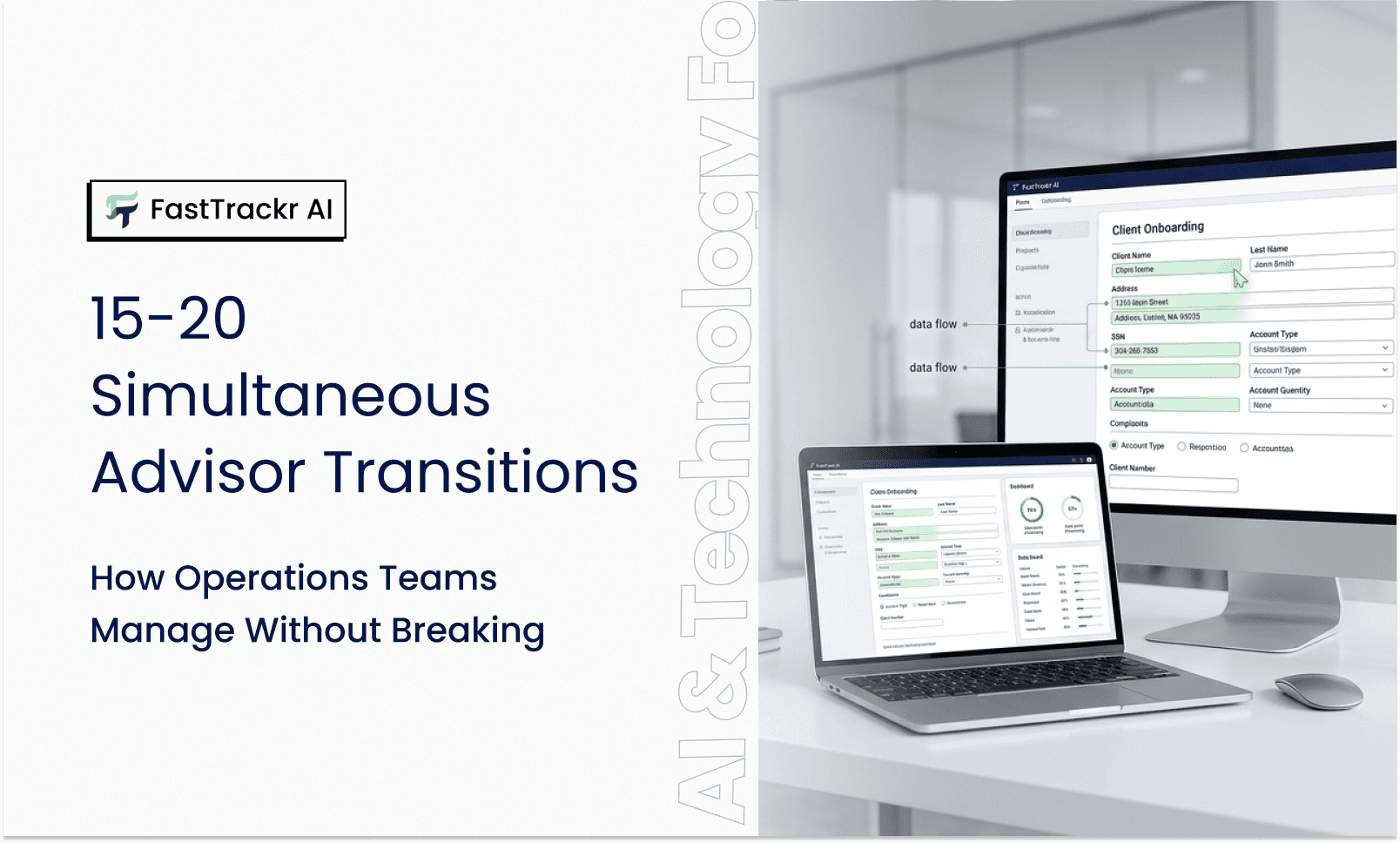
The consultant who manages 50 transitions a year isn't working harder than the one managing 10. They have a system. Managing 15–20 simultaneous advisor transitions isn't about bandwidth — it's about architecture. The ops teams that run at this volume have centralized tracking, parallel workflows, exception management that surfaces problems before they cascade, and a technology layer that handles coordination complexity so the team can focus on judgment calls instead of status updates. Here's that system.
What Breaks When You Scale With the Same Tools
Single-transition tools don't fail gracefully at 15 simultaneous moves. They fail suddenly. And the failure mode is always the same: visibility collapse.
The team loses track of which accounts are stuck, which exceptions are unresolved, which advisors are at risk of falling behind — not because anyone is negligent, but because the information lives in too many places at once. Raymond James describes building "a customized transition calendar for each advisor across departments: licensing, repapering, technology training, client experience". That model works for one advisor at a time. Fifteen customized calendars maintained in a project management tool or spreadsheet don't scale. They become an information management problem disguised as a transition management problem.
Three failure modes show up consistently when teams scale with the wrong tools:
Exception blindness. A rejected form sits unresolved for five business days because no one noticed it amid the volume of other submissions. Every day in transition is a day for that client to reconsider. Five days of exception blindness is five days too many.
Advisor priority conflicts. Two high-value advisors hit critical milestones simultaneously. The team lacks a clear escalation protocol for which gets priority attention. Someone makes a judgment call under pressure. Sometimes it's wrong.
Capacity overcommit. A new transition gets accepted before the current batch is complete. Attention spreads too thin across too many active deadlines. Quality degrades. Exceptions stack up.
Each of these is a structural problem, not a staffing problem. Adding a coordinator doesn't fix exception blindness. A centralized tracking system does.
The Operational Architecture: Team Structure and Capacity Math
High-volume transition ops runs on three distinct roles. Each requires a different skill set. Conflating them — having one person do all three — is the fastest route to burnout and errors.
The Transition Operations Manager owns the end-to-end process across all active transitions. Capacity planning, advisor prioritization when conflicts arise, escalation decisions on stuck exceptions, and the relationship with the transition platform vendor. One TOM can oversee 15–20 simultaneous transitions with the right platform. Without centralized tracking tooling, that number drops to 5–7.
Transition Coordinators own the execution layer for a defined set of advisors: form generation, submission, tracking, exception resolution, client communication coordination. As Kitces notes on advisory firm workflows, the average firm has 15–20 core processes. In a high-volume transition ops context, one coordinator with purpose-built tooling manages 4–6 active advisor transitions simultaneously. Without dedicated tooling, that number is 2–3.
The Data Quality Specialist audits incoming CRM data before each new transition launches. This role prevents downstream NIGO errors by catching data problems at the source — before they become form rejections. One DQS supporting a 15+ transition team is sufficient when the audit process is standardized. Without a defined audit protocol, data quality work gets absorbed by coordinators and reduces their transition capacity.
Capacity math: one TOM, three coordinators, and one DQS can run 12–18 simultaneous advisor transitions at high quality with purpose-built tooling. Without it, the same team manages 6–9 before quality degrades.
Technology: What High-Volume Ops Teams Actually Use (And What They've Stopped Using)
The technology stack for high-volume transition operations has evolved significantly in the last two years. The firms still running on spreadsheets and email aren't managing 15 simultaneous transitions. They're managing six and wondering why they're overwhelmed.
The non-negotiable layer is a transition management platform that provides centralized status tracking at the account level — not the advisor level. Automated form generation with custodian-specific validation. Exception management with reason codes and resolution tracking. Advisor and client communication workflows. FastTrackr was purpose-built for this use case — designed from day one for the consultant running 15 transitions simultaneously, not the one managing one per month. The real competitor isn't Docupace. It's the spreadsheet.
The second layer is CRM integration that feeds the form generation layer without manual re-entry. A 90% reduction in manual data entry isn't just a time saving. It's a quality metric. Every manual entry is a potential data error that generates a NIGO.
What high-volume teams have stopped using: individual project management tools (Asana, Monday, Trello) for transition status tracking. These tools were designed for project tasks. They don't surface exceptions automatically. They don't flag which specific account has been in rejected status for three days. They require manual updates that coordinators can't sustain under volume pressure.
The Parallel Workflow: How to Track 15 Transitions Without Losing a Single Advisor
The parallel workflow treats each advisor transition as an independent process stream with a shared exception management layer. The streams run simultaneously. The exceptions surface into a single view.
For each active transition, the status at any moment should be expressible as a single number: percentage of accounts in five states — pre-submitted, submitted pending custodian review, approved, rejected with reason, and completed. When that number is visible for all 15 transitions simultaneously, the TOM scans the rejected column. Not to review everything. Just to catch anything stuck for more than one business day.
Integrated Partners' transition management approach emphasizes the critical role of standardized playbooks for managing the advisor relationship during parallel runs. The playbook matters as much as the tooling: when every coordinator handles exceptions the same way, the TOM can review outcomes without re-learning a different process per coordinator.
The practical cadence for a team running 15–20 simultaneous transitions: a daily 15-minute standup covering only exceptions and new escalations. A weekly advisor-level status review for all active transitions. Monthly capacity planning to project upcoming volume and identify resource needs before they become crises.
Exception Management: Handling Problems Without Disrupting the Other 14
Exceptions are inevitable even in well-run parallel transition environments. The question isn't whether they'll occur. It's whether the team catches them in hours or days.
The exception management protocol that works at scale: every rejection surfaces automatically with a reason code and an assigned coordinator. A 24-hour resolution target from the time of rejection. An escalation path to the TOM if the resolution isn't clear within four hours. TradePMR's approach to transition planning emphasizes running parallel systems during a conversion — the same principle applies to exception management. While one coordinator resolves a Schwab rejection, the rest of their portfolio continues moving forward independently.
The exception management failure mode at scale is prioritization confusion: two advisors have active exceptions simultaneously, both believe theirs should be resolved first, and the coordinator handling both doesn't have a rule for which to address when the resolution steps conflict in time. The answer is a written escalation matrix, not a judgment call in the moment. High-value advisors with tighter timelines escalate to TOM review. Exceptions with compliance implications escalate regardless of advisor status. Routine rejections with known resolution paths are handled by the coordinator directly.
Frequently Asked Questions
What is the organizational structure for an ops team handling 15+ simultaneous transitions?
The minimum viable structure is a Transition Operations Manager overseeing all active transitions, Transition Coordinators managing 4–6 advisor transitions each with purpose-built tooling, and a Data Quality Specialist auditing incoming CRM data before each new transition launches. A team of five — 1 TOM, 3 coordinators, 1 DQS — can manage 12–18 simultaneous transitions with the right platform. Without dedicated tooling, the same team manages 6–9 before quality degrades.
How do you track progress across 15 advisor transitions without a dedicated transition platform?
You can't. Not reliably. Spreadsheets and project management tools lack account-level tracking, automatic exception surfacing, and custodian-specific status visibility. Teams running 15+ simultaneous transitions without a purpose-built platform consistently run into exception blindness — the failure mode where a rejected form sits unnoticed for days. The tooling isn't optional at this scale. It's the difference between managing 15 transitions and managing 6.
What are the top 3 failure modes when running simultaneous transitions at scale?
Exception blindness — rejected forms going unnoticed for multiple business days. Advisor priority conflicts — two advisors hitting critical milestones simultaneously without a clear escalation protocol. And capacity overcommit — accepting new transitions before current ones are complete. All three are structural problems, not staffing problems. They're solved by centralized tracking with automatic exception surfacing, a written escalation matrix, and a formal capacity planning process.
How do you prioritize when two transitions hit a problem on the same day?
A written escalation matrix removes the judgment call from the moment of conflict. The matrix defines priority tiers: advisors with contractual transition deadlines first, then advisors whose exceptions have compliance implications, then advisors ranked by AUM or strategic importance. When two exceptions require the same coordinator's attention at the same time, the matrix determines priority without requiring a judgment call under pressure.
What technology stack does a high-volume transition ops team actually need?
Three non-negotiable components: a transition management platform with centralized account-level status tracking, automated form generation with custodian-specific validation, and exception management with reason codes. Plus CRM integration that feeds form generation without manual re-entry. Project management tools and spreadsheets aren't substitutes for these at scale. The real competitor is the spreadsheet — and the spreadsheet loses at 15 transitions.
How do you maintain compliance documentation across 15 transitions simultaneously?
Each transition generates a compliance record: all forms submitted, all rejections with reason codes, all corrections made, all final confirmations of account transfer completion. The transition platform should maintain this record automatically as part of its tracking function. At 15 simultaneous transitions, manual compliance documentation isn't sustainable. Automated audit trail capture is a required platform feature, not a nice-to-have.
What client communication cadence works when managing dozens of advisors in transition?
Advisor-to-client communication should be standardized and advisor-branded, triggered by the platform at defined milestones: initiation notice when repapering begins, signature request when forms are ready, and completion confirmation when accounts have transferred. The advisor delivers the communications. The platform triggers them. This maintains the advisor relationship during the transition without creating a separate communication management workload for the ops team.
How do you measure operational capacity — how many transitions can one ops specialist handle?
With purpose-built transition tooling, one coordinator handles 4–6 simultaneous advisor transitions at quality. Without dedicated tooling, that number is 2–3. The capacity math is driven by exception volume, not total transitions. Teams running at or above capacity consistently show lower exception resolution rates and higher client-visible error rates. Plan for 1–2 exceptions per advisor per transition cycle and size accordingly.
The consultant who manages 50 transitions a year isn't working harder than the one managing 10. They have a system. Centralized tracking. Parallel workflows. Automatic exception surfacing. A platform that handles the coordination complexity so the team focuses on judgment calls, not status updates. Transitions don't have to be this hard. But they will be — until the architecture catches up to the volume.
Read More Articles

Step-by-Step Guide to Running a Zero-NIGO Advisor Transition for a $300M Book
Step-by-Step Guide to Running a Zero-NIGO Advisor Transition for a $300M Book

Understanding Custodial Transfer Requirements: ACATS vs. Non-ACATS for Advisor Transitions
Understanding Custodial Transfer Requirements: ACATS vs. Non-ACATS for Advisor Transitions

How to Automate Form Population Across Multiple Custodians for Advisor Transitions